FOS at ICTC 2026
Foundations of Success is excited to take part in the first ever International Conservation Technology Conference (ICTC 2026), co-organized by WILDLABS and a coalition of partners. We'll be at both the pre-conference workshops and the main conference in Lima, Peru bringing you some of our newest insights and most trusted tools. Registration is open until 6 February!
Find us here
Pre-conference half-day workshop: Strategy to Impact: Practical Training in the Conservation Standards & Miradi (organizers: Kari Stiles / FOS, Sara Estlander / FOS Europe, Brian Knowles / Miradi Software, and Annette Stewart / CMP & Bush Heritage Australia), Monday 16 February.
In the session Data-Driven Decision-Making for Conservation and Policy, Wednesday 18 February:
- Miradi Software - Support for strategic decision-making to enhance tactical responses (speakers: Kari Stiles, Miradi Project Manager & Brian Knowles, Miradi Tech Lead)
- From Plan to Patrol: Closing the Adaptive Management Loop with Conservation Data Flows (organizers: Kari Stiles, Miradi Project Manager; Brian Knowles, Miradi Tech Lead; Xavier Espiau, Northern Land Council; Justin Steventon, CyberTracker & SMART)
- From data to decisions: A question-first approach for conservation impact (speakers: Sara Estlander / FOS Europe, Annette Stewart / Conservation Measures Partnership & Bush Heritage Australia)
- More time talking, less time trawling: AI-powered assessment of diverse conservation evidence (speaker: Sara Estlander / FOS Europe)
- From Silos to Systems: The Case for Conservation Data Standards (speakers: Annette Stewart / Conservation Measures Partnership & Bush Heritage Australia; Kari Stiles / Foundations of Success / Brian Knowles, Miradi Software)
In addition, you will find us in the exhibition hall at the CMP/Miradi booth. And check out some of the exciting sessions by our partners!
Strategy to Impact: Practical Training in the Conservation Standards & Miradi
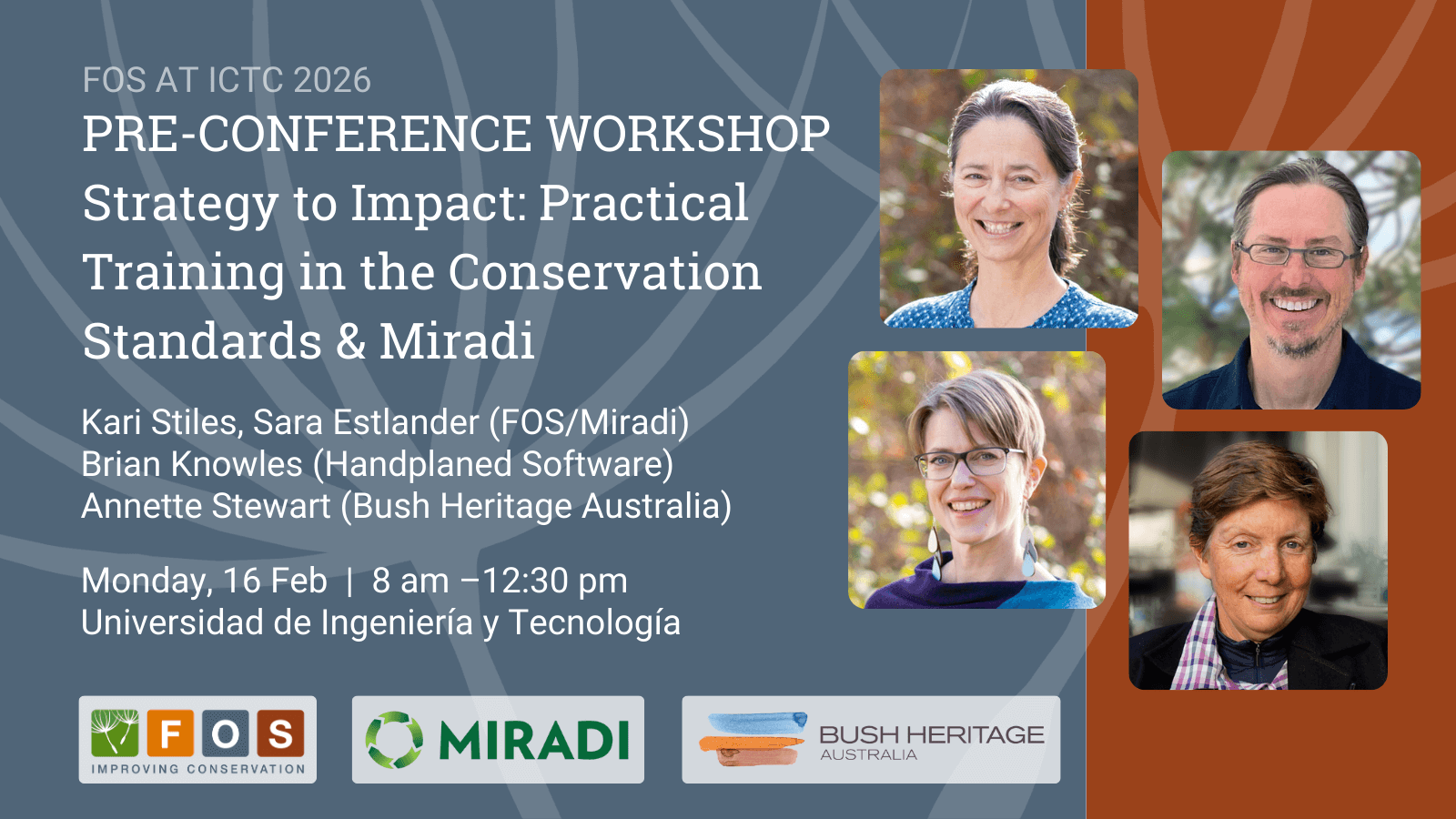
Mon 16 Feb, 8 AM –12:30 PM, Universidad de Ingeniería y Tecnología (UTEC)
Organizers:
Kari Stiles, Miradi Project Manager
Sara Estlander, Miradi UX Designer
Brian Knowles, Miradi Technical Lead
Annette Stewart, Conservation Measures Partnership & Bush Heritage Australia
This workshop uses the Conservation Standards (CS) methodology and Miradi software to equip participants with the skills to design, manage, and refine conservation projects and programs, and maintain a high quality, structured database. Participants will leave with the ability to build and manage a project in Miradi, develop work plans grounded in a robust theory of change, create monitoring plans focused on the highest priority, decision-critical information, and export data for use in other commonly used applications. This training supports organizational accountability, maximizes resource efficiency, and ensures monitoring efforts focus on highest priority data. As our capacity to collect data grows, it is increasingly important that we invest in making sure our data collection is focused on the most useful information, not just the most available information. By establishing a clear planning pathway and adaptive management processes and tools (e.g., measurable objectives), participants ensure their field actions (the tactical responses) are purposeful, effective, and defensible to funders.
Throughout the workshop, training exercises will emphasize the relationship and connections between business processes and conservation technology, differentiating between strategic processes and technologies (like the CS and Miradi) and tactical responses and technologies (like SMART and EarthRanger). We will discuss the key elements of a structured conservation dataset, and we will explore data integration pathways to support adaptive management, including tools for manual data sharing between platforms and the Miradi API. No prior experience with the CS or Miradi is required. Participants must bring a laptop with Wi-Fi access. A complementary 60-day Miradi trial license and access to the full suite of Miradi features will be provided.
Registration is closed.
From Plan to Patrol: Closing the Adaptive Management Loop with Conservation Data Flows
Wed 18 Feb, 11:00 AM –12:00 PM, Cusco 3
Organizers:
Kari Stiles, Miradi Project Manager
Brian Knowles, Miradi Tech Lead
Xavier Espiau, Northern Land Council
Justin Steventon, CyberTracker, SMART
To adaptively manage conservation efforts and achieve maximum conservation impact with limited resources, teams must bridge the data gap between strategic planning, implementation and monitoring. This interactive session shares practical ways to connect Miradi (strategic planning) with real-time tools such as SMART, and invites participant input to shape future integrations. We present a case study of an organisation already using the Miradi API to link these systems, then preview a pilot that connects planning platforms with data collection tools. Participants will share experiences and data-sharing needs to prioritise data elements and data flows for bi-directional integration, helping to shape future development of Miradi and the broader conservation technology ecosystem.
Miradi Software - Support for strategic decision-making to enhance tactical responses
Wed 18 Feb, 1:50 PM –2:00 PM, Cusco 3
Speakers:
Kari Stiles, Miradi Project Manager
Brian Knowles, Miradi Technical Lead
This session introduces Miradi and demonstrates how teams use it to develop measurable, manageable strategic plans to guide their on-the-ground work and increase conservation impact. We will use case studies to showcase how Miradi is used in combination with other conservation tech to guide the work of on-the-ground patrols, ensure monitoring efforts are focused on the highest priority data collection needs, and feed information back into Miradi to support analysis and adaptation of conservation plans. Case studies will include examples from small local NGOs to large, country-wide governmental agencies, and will span the range of conservation efforts including protected area management, species-specific conservation, and threat-reduction efforts such as combatting wildlife trafficking.
From data to decisions: A question-first approach for conservation impact
Wed 18 Feb, 2:00 PM –2:10 PM, Cusco 3
Speakers:
Sara Estlander, FOS Europe
Annette Stewart, Conservation Measures Partnership & Bush Heritage Australia
Conservation projects often invest heavily in data collection but remain “data-rich and information-poor.” This session introduces a question-first approach that starts with critical management decisions rather than raw data. We’ll explore why traditional data-first methods fail, present a user-centred design process, and showcase real-world dashboards built to answer key questions and drive adaptive management. Attendees will gain practical insights to optimise monitoring, save resources, and ensure data truly informs strategic action for greater conservation impact.
More time talking, less time trawling: AI-powered assessment of diverse conservation evidence
Wed 18 Feb, 2:20 PM –2:30 PM, Cusco 3
Speaker: Sara Estlander, FOS Europe
Stop drowning in different types of evidence – use AI to start making sense of it! This session introduces the BEAM (Balance Evidence Assessment Method) Agent, a new AI tool designed to automate the laborious process of sifting through and analysing diverse conservation evidence, from scientific papers to grey literature and local testimony. We will demonstrate how this tool quickly processes complex information and assesses it in light of learning topics, freeing teams from tedious, time-consuming analysis. The result: more time for the crucial human work of interpretation, collaborative discussion, and translating insights into effective conservation action.
Read more about BEAM:
- Journal article introducing the method: Christie et al. (2023) Assessing diverse evidence to improve conservation decision-making
- Conservation Learning Initiative
From Silos to Systems: The Case for Conservation Data Standards
Wed 18 Feb, 3:30 PM –5:00 PM, Cusco 3
Speakers:
Annette Stewart, Conservation Measures Partnership & Bush Heritage Australia
Kari Stiles, Foundations of Success
Brian Knowles, Miradi Software
Conservation projects generate diverse datasets—from species observations and habitat maps to threat assessments and community metrics. Yet without shared data standards, these datasets remain siloed, limiting collaboration and tool integration. This session explores the transformative potential of an integrated set of data standards for conservation. We’ll examine key benefits including interoperability, data sharing, and scalability, and showcase a real-world example where standardization of conservation project information has accelerated impact. Participants will engage in a collaborative discussion to identify existing de-facto standards and pathways toward consensus - a roadmap to smarter, more connected conservation.
Learn about the Conservation Standards and Miradi Adaptive Management Software
Come visit the double booth for the Conservation Measures Partnership and Miradi in the exhibition hall! Learn about what's new in CS 5.0 and the new and upcoming features of Miradi.
Sessions by FOS partners
Don’t miss these exciting sessions by our partners!
- Talk to Your Data: AI-Powered Conservation Analysis with Brian Knowles, Miradi Technical Lead. Thu Feb 19, 2:00 pm – 3:00 pm, Cusco 1
See the full conference agenda on the conference website.
Photo credit: Nature.Catcher, Flickr (cropped and rotated). CC BY-SA 2.0